
Hardware-Grade Power Loss Protection (PLP)
Safeguarding critical data integrity and consistency during abrupt power outages, building an impregnable line of defense for hyperscale datacenters and mission-critical workloads.
Executive Summary
Hardware power loss protection uses stored energy to give the device time to handle a power interruption. Identify the protected data and firmware recovery path when evaluating a drive. Include power-interruption and recovery results in device qualification.
Microsecond Energy Handover & Safe Flush Upon Power Cut
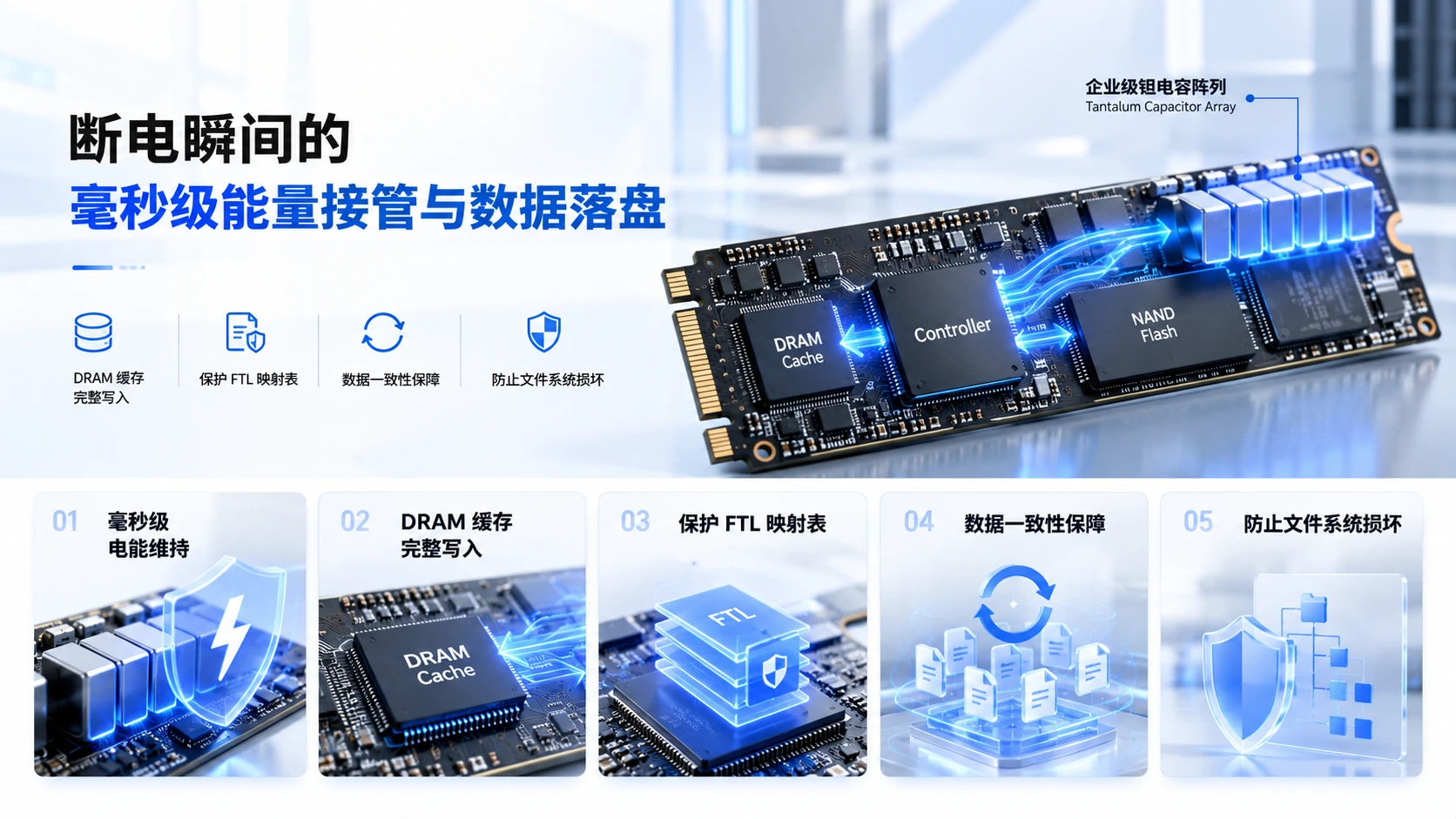
When input power is abruptly interrupted, onboard tantalum capacitor banks take over within milliseconds, enabling the controller and DRAM cache to execute safe flushes of uncommitted writes and protect critical mapping tables.
Core Technical Characteristics
Stored energy gives controller firmware time to protect selected in-flight data during power interruption.
Millisecond Hold-up Time
Instantaneous ms-level response seamlessly handover to internal capacitive energy during sudden outages.
Enterprise Tantalum Capacitors
Industrial tantalum arrays sustain exceptional electrical stability across high-temp and high-vibration conditions.
DRAM Buffer Protection
The controller uses the hold-up interval to write protected data from DRAM to NAND.
FTL Integrity Protection
FTL Integrity Shield prevents fatal corruption of the critical logical-to-physical address translation table.
Data Loss Prevention
Eliminates filesystem corruption and metadata loss caused by unexpected host power collapse.
Hardware PLP vs. Non-PLP Storage Comparison
Evaluate the decisive value of enterprise power loss protection under extreme unexpected outage scenarios.
| Failure Scenario | Standard Non-PLP Drive | FuEpoch Enterprise PLP Architecture |
|---|---|---|
| Abrupt Power Cut | Uncommitted DRAM cache data is permanently lost | Capacitor banks provide instant holdup; DRAM fully flushes to NAND |
| Interrupted Write | Metadata scrambled; triggers bad blocks and volume corruption | Transaction completed safely; structure remains fully consistent |
| FTL Table State | Translation table corrupted, causing total drive bricking or lockup | FTL table saved intact; instant recovery upon next host power-up |
| Business Continuity | Exorbitant data recovery fees and severe server downtime risks | Reduces the risk of losing protected in-flight data during a power interruption |
High-Reliability Application Scenarios
Tailored for 24×7 high-concurrency, zero-downtime tolerance mission-critical infrastructure.